


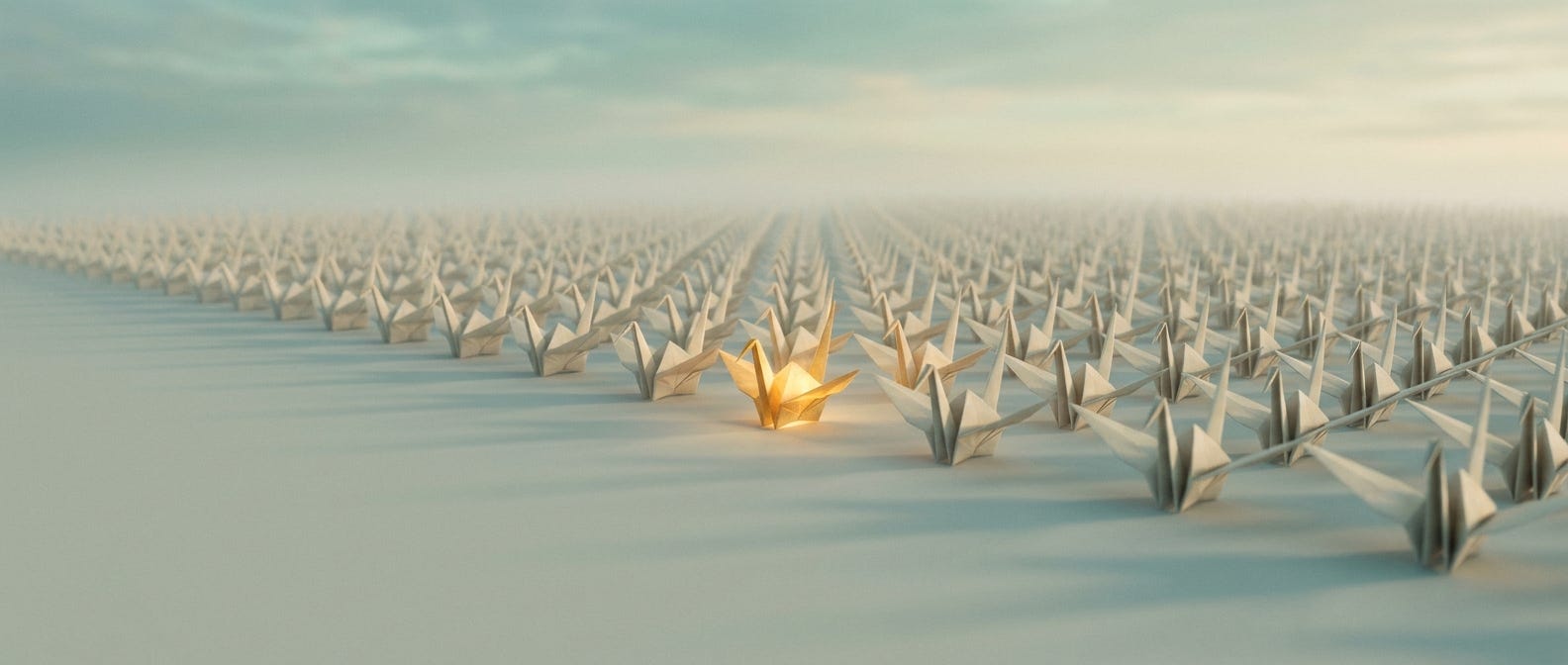
TLDR: AI didn’t kill anyone’s creativity. It did something stranger. It raised the floor for each of us, and when we all reach for the same tool the same way, it narrows the range for everyone at once. Both effects are real, and a follow-up study suggests the narrowing isn’t inevitable. Originality can survive AI if you protect it on purpose.
In March 2025, millions of people turned their selfies into Studio Ghibli scenes in a single afternoon. Sam Altman wore one as his profile picture. Then Ghibli’s home country asked OpenAI to stop.
For an afternoon, everyone was an illustrator. It looked like creativity handed to the whole world at once. I wanted to know what it actually was.
When Everyone Can Make Anything
That afternoon felt like a gift. A studio’s entire visual language, the thing Miyazaki spent a lifetime drawing by hand, was suddenly sitting behind a button on anyone’s phone. I made a few myself. They were lovely. They also took no time and nothing of mine, and that is a strange thing to feel proud of.
Miyazaki saw some version of this coming. Years ago someone showed him an early AI animation, a body dragging itself across a floor, and after a long silence he called it “an insult to life itself.” He was reacting to something cruder than a Ghibli filter, so the quote gets stretched further than he meant it. But the discomfort rhymes. The look he built by hand became, in March, a filter you could tap.
And the tapping doesn’t stop at images. On Deezer, 44% of everything uploaded is now AI-generated, somewhere around 75,000 tracks a day, and the platform flags most of the streams on them as fraud. Nobody can listen to that much music. It gets made anyway, because making it costs nothing now.
The flood turns ordinary fast, and the tools behind it age out just as fast. Sora looked like the future of film two years ago and has already been shut down. Midjourney is on its eighth version. When I first got curious about all this, the tools were the whole story, the plain shock that a machine could do it at all. That shock wore off, and it left a better question behind.
The machines can make almost anything now. So when everyone can make anything, what does everyone actually make?
The Study
Someone finally measured a piece of that. In July 2024, two researchers, Anil Doshi and Oliver Hauser, published a controlled experiment in Science Advances. They asked 293 people to write a short story for young adults. Some wrote alone. Some could pull story ideas from GPT-4. Then 600 strangers rated the results, blind to who used what.
The first finding is the good news, and it holds up. On your own, AI makes you better:
Stories written with AI ideas scored 8.1% higher on novelty and 9% higher on usefulness.
The writers rated least creative going in gained the most, up to 26.6% better written and 15.2% less boring.
AI pulled the weaker writers up level with the stronger ones.
I feel this in my own work. When I draft with Claude, my floor rises. The bad first version never reaches the page, and the one that does is a version I’d have been glad to write on my own. If the study ended here, it would be a simple story: the tool lifts the person.
Read that back, though. It’s the individual effect. One writer, working alone, comes out ahead. The study has a second half, and the second half is where it turns strange.
The Catch
The same stories that read as more creative one by one turned out more alike as a group.
Writers who used AI ideas produced stories 10.7% more similar to each other than the writers who worked alone.
Doshi and Hauser call it a social dilemma. Every writer is better off reaching for the AI. And every time one does, the shared pool of stories narrows a little.
The mechanism is simple, and it took me a second to feel the weight of it. You raise your own floor by reaching for the same ideas everyone else is reaching for. Multiply one person’s small private gain by a few million people and one shared model, and you land back at that Deezer number. Not 75,000 bad songs a day. 75,000 songs a day that sound like each other.
That is the default at scale. Which left me with an obvious suspicion. If everyone who uses the tool drifts toward the same place, maybe the tool itself has a center of gravity.
Why It Clusters
So I went looking at what the machine does on its own, with no human in the loop to blame.
On the standard creativity tests it looks brilliant. Scored against roughly 2,700 people on the Torrance test, GPT-4 landed in the 99th percentile for originality. It aces the exams we built to measure human imagination.
Then a 2025 study asked a sharper question, and the shine came off. The models beat the average human, yes. But only 0.28% of their answers reached the top 10% of human responses. AI turns out to be a machine for the above-average. It clears the bar almost everyone clears, and rarely gets near the top.
Margaret Boden named the reason decades before anyone could test it. She split creativity into three kinds: combining old ideas into new ones, exploring inside a fixed set of rules, and transforming the rules themselves. Language models are strong at the first two and weak at the third. They recombine and they explore. Changing the rules of the game is the part they can imitate but not own. New mixtures, rarely a new rule.
That is why the crowd converges. Left to its defaults, the model reaches for the center of everything it has seen, and everyone who trusts that reach lands in the same neighborhood.
P.S. I am running a free 3-part masterclass on Claude Skills, on Maven. Claude skills have become a powerful primitive for personal and team automations. Join me to learn how to build skills from scratch and watch a single skill orchestrate a team of agents. Save a spot here.

Does the Process Matter?
That word, imitate, kept snagging on me. If the machine only recombines, if it imitates creativity without ever originating it, does that make what it produces less creative? The argument is older than AI. If a poem moves you, does it matter that nothing was moved to write it?
One camp says creativity belongs to the maker, to the understanding and the intent behind the work. By that measure a model predicting the next likely word is producing what the creativity researcher David Cropley calls pseudo-creativity, the look of the thing without the process behind it.
The other camp says we already judge a poem or a proof by the work itself, never by a look inside the author’s head. Boden’s own test for a creative idea is that it be new, surprising, and valuable, and all three of those are properties of the output, available to anyone reading it. If the artifact clears that bar, the machinery behind it is beside the point.
I land on both sides depending on the day. A generated image can genuinely stop me. Something clicks, and I feel it before I decide whether I’m allowed to. Then I remember the click was mine. The output moved me. Nothing on the other end was moving.
That argument is a good one to have, and in the end it sits to the side of the practical problem. Creative or not, the machine pulls everyone toward the same middle. What matters is whether we have to follow it there. And on that, the research finally handed me something hopeful.
Originality Becomes a Choice
The flattening isn’t baked into the machine. A second experiment showed me why.
In 2025 another team rebuilt the Doshi-Hauser study with one change. Instead of everyone drawing ideas from the same default model voice, they pulled them from ten different AI personas. The homogenization disappeared. Collective diversity held, and in one condition it beat the human-only baseline.
Same models. Same task. The only thing that moved was whether the inputs converged or varied. So the sameness never came from AI being AI. It came from all of us using it the same way, out of the box, on the setting it shipped with.
That single change rearranged how I’d been reading everything above it. The default pulls toward the average and the familiar, and if you take what it hands you, you drift there with everyone else. But a default is a setting, and settings can be changed.
In practice that means treating the first answer as a starting point to argue with. It means bringing your own rough idea before you ask for its polished one, or handing the model a constraint it would never pick on its own. The people who stay original with these tools are the ones who make the machine work inside their own frame.
So the answer to the question I opened with is not as clean as I wanted, and better than I feared. You can still make original work with AI. Its first answer just won’t be the original one. The model hands you the safe, average version, the same one it hands everyone else who asks. The originality is in what you do after you reject that first version, and that part is now on you. Originality can survive AI, if you protect it on purpose.
Open Questions
If AI raises the floor and narrows the range, is a world of better-average, less-original work a good trade? For a marketer, maybe. For a culture, I’m not sure.
The persona study says diversity is recoverable. Recoverable by whom? The default setting is where almost all the usage stays.
The Ghibli afternoon put a studio’s life’s work in everyone’s hands in an hour. It was thrilling, and it made one thing look like a million. I can’t decide which of those two is the real headline.
Written by chasing a question I keep coming back to and checking my instinct against the studies. Every number is linked below.
Raising the floor while narrowing the range for everyone at once is the precise version of a thing people usually describe badly. Most critiques either say AI kills creativity or say it does not, and both miss that the interesting effect is distributional. Everyone converging on the same tool used the same way produces variety loss even while individual output quality goes up, which is a genuinely different problem than the one usually being argued about, and it needs a different fix than either side is proposing.